Microsoft says the system could be used to incentivize users to perform certain tasks. Scanners can detect activity from certain kinds of tasks, such as mental concentration when reading an advert, that can verify blocks and reward the user with cryptocurrencies.
Microsoft has proposed a system that can mine cryptocurrencies using data collected from humans as they exercise or read an advertisement.
In a patent application filed with the World Intellectual Property Organization (WIPO) Thursday, the American computer giant said sensors could detect activity associated with specific tasks – such as time spent viewing ads – and convert it into computer-readable data to solve computational problems, in much the same way as a conventional proof-of-work system.
«Instead of massive computation work required by some conventional cryptocurrency systems, data generated based on the body activity of the user can be a proof-of-work, and therefore, a user can solve the computationally difficult problem unconsciously,» the patent application reads.
The system could use physical exertion to mine cryptocurrencies: sensors could detect when the body is doing a physical task, such as a faster pulse, and use that data to unlock blocks. Scanners connected to the head could even use brainwaves, signals sent out during mental exertion, to mine for cryptocurrencies.
In late 2017, a Netherlands-based company explored whether humans produced enough energy to mine cryptocurrencies. Their test results found body heat from 37 people, collected over a couple of hours, produced enough energy for a computer to mine continuously for just over eight days.
Although Microsoft designed the system, it is unclear whether the company is moving forward on actually creating it. It is also not clear whether the protocol would run off a fork of an existing protocol, or based on a whole new blockchain entirely.
Microsoft suggested in its patent application that the system would be fully centralized.

Mining Sector Sees Extreme Volatility Amid Coronavirus and Crash During Q1
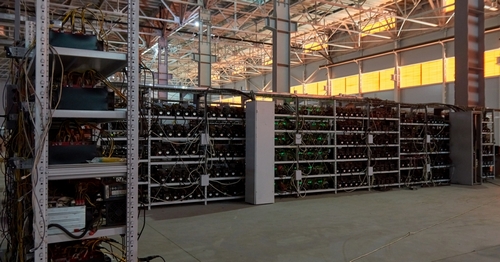
Crypto research firm, TokenInsight, has published a report covering the crypto mining industry during the first quarter of 2020. The report emphasized swings in Bitcoin’s hash rate and the phasing out of older ASIC models.
However, volatility has had a greater impact on Chinese miners — with Antminer S9s becoming unprofitable during March.
Miners using old ASICs are impacted by price crash
The report describes BTC hash rate as having been “extremely volatile” during the early months of 2020 — ranging from between roughly 70 exahashes per second (EH/s) and 100 EH/s.
According to the report, the profit margins of older ASIC units are “being squeezed out by the newer generation miners.”
TokenInsight finds that the profitability of Bitmain’s Antminer S9’s was approximately 35% in the early months of 2020 before plummeting into negative territory amid the March crypto crash. However, the report notes that the profitability of S9’s rebounded back to roughly 20% during April.
Uneven geographic impact of COVID-19 on mining
While the report notes that that the coronavirus pandemic has had “a negative impact on mining farms globally”, Chinese miners have been the hardest hit as many operators in the west have adapted to the crisis by reorganizing operations.
At the start of April, Cointelegraph reported that 40 mining operations in China were forced to shut down as the March crash rendered S9-based companies unprofitable — with F2pool reporting that roughly 2.3 million miners had gone offline since Mach 10.
Further, supply chain shocks have resulted in delays to the expected shipping dates for next-generation ASICs in June, fuelling predictions.
ASIC manufacturers target new algorithms
Despite a 60% crash in the number of new ASIC miners coming online quarter-over-quarter, the firm reports that Q1 2020 saw the highest number of ASICs active on the Bitcoin network in three years.
The report also identifies that the majority ASICs available on the market today are designed for algorithms other than Bitcoin’s SHA-256 — with 86 SHA-256 miners compared to the 97 ASICs available for various altcoins.